
O Language Travels é um projeto de divulgação linguística criado pelo linguista e historiador português Marco Neves. É dedicado à história das línguas, à origem das palavras e às relações entre diferentes idiomas e culturas.
Pode consultar o projeto na página oficial: Language Travels — Marco Neves.
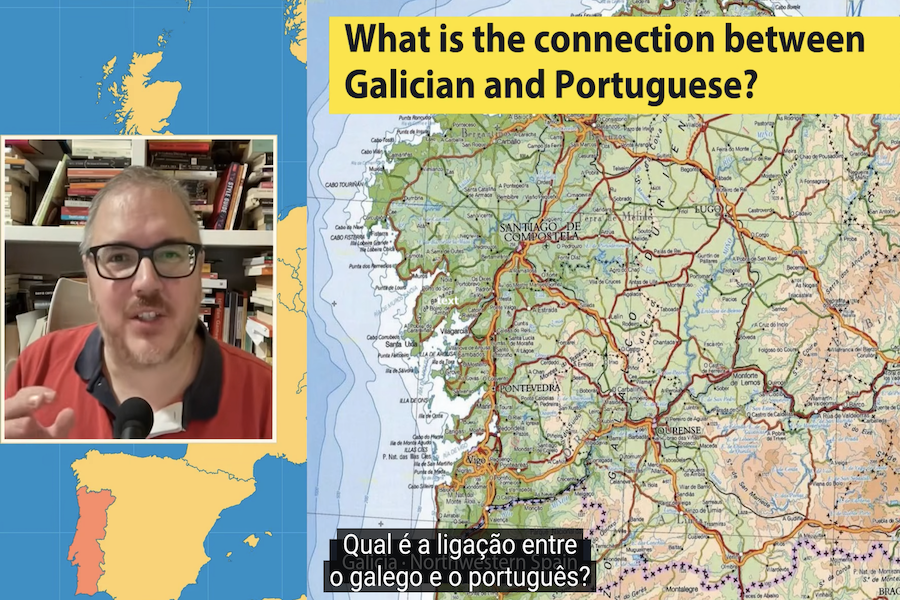
So what is the connection between Galician and Portuguese?
You may be aware that Spain has more than one language. The main one, or the language spoken by most people, is Spanish, called español or castellano in Spanish. But there are other languages, and other languages considered official languages in some regions. For example, in Galicia, a region in the northwest part of Spain, above Portugal, the official languages are Spanish and Galician. In fact, in some areas, for example place names, the only official language is Galician. So all place names in Galicia are officially in Galician. For example, the city of Coruña is officially called A Coruña in Galician and not La Coruña in Spanish.
[A shared origin]
So where does Galician come from? In fact, it comes from the very same place as Portuguese. And I should now tell the story very quickly. All Romance languages in the Iberian Peninsula come from Latin as it was spoken in the Iberian Peninsula. This seems obvious, but I should remind you of this. All these languages come from the same source language. There is still one language spoken today that doesn’t come from Latin, and that is Basque. But all the other Iberian languages come from the same source, but they had different stories, so to speak.
This map is a map of the linguistic situation in the Iberian Peninsula around the 11th century. So you can see that Latin was now divided, so to speak, into different dialects that were becoming languages, and the exact place or the exact moment where they became languages is not known because it’s simply a choice where we want to put the border, the temporal border between Latin and the languages that came afterwards.
By the way, this big area in the south was under Muslim rule, and we could hear Arabic, Mozarabic, which was a Romance language spoken in Muslim-controlled areas, and quite probably Amazigh languages, languages from the north of Africa.
Let’s look at that band in the north. On the right, we have what would become Catalan and Valencian. Then, to the right, we have Aragonese, which is now spoken by very few people. Then we have the central band, which is Castilian, which ended up quite enlarged as it came to the south and is today called, in English at least, Spanish. That is the main language of Spain, but it is far from the only one.
Then we have Asturian, the second most western band. Asturian could also be called Leonese, from the kingdom of León. And today it is becoming official in Asturias, the northern region, and it is also considered official in a very specific standard in Portugal, in northeast Portugal, in Miranda do Douro, where the language is known as Mirandese.
And then we have the westernmost band, that is Galician and Portuguese.
So when those Christian kingdoms came south, they started conquering territories to the south. We had these five bands going south too. And if we look at the westernmost band, we can see that it is the same in the sense that both present-day Galician and Portuguese come from Latin spoken in that specific territorial band.
[A border, two histories]
However, there was a very steep political separation in the middle of this band. Not in the middle, in fact, but in a horizontal way, where Portugal became separated from Galicia in the 12th century. This is a very old political separation. In fact, this border is one of the oldest in the world. However, this border did not change the fact that, to the north and to the south, the language has the same origin. The origin is the specific evolution of Latin in the northwest part of Iberia.
So when Portugal became a separate kingdom in the 12th century, the language did not change. So there was no very big difference between what was spoken to the north of the border and to the south of the border.
This language was later, much later, named Galician-Portuguese. But this is a very recent name. It comes probably from the 19th century. So in the 12th century, this language was used by poets, and it was a very important literary language. It was even used by Castilian kings to write poetry.
But since Galicia to the north became part of the Castilian Crown and later on part of a very strong Spanish state, and Portugal became an independent kingdom, apart from 60 years when Portugal was also part of the Castilian Crown… In fact, it was not part of this crown but had the very same king.
But apart from those 60 years, we have a situation which can almost be called a linguistic experiment.
To the south, that original linguistic material became the national language of Portugal and became a very prestigious language.
To the north, that very same material became Galician, which was not official. And even if it was spoken by everyone, it was used less and less in writing and was not the language of a kingdom. Or at least, well, it was the language of a, so to speak, kingdom, but that kingdom was just part of a very powerful crown, the Castilian Crown.
[Literature and spelling]
In the 19th century, Galician started being used again in literature, in that very Romantic movement of trying to find the medieval roots of all the peoples of Europe. And the Galician people also had this movement, this literary movement. And so some people started writing poems, for example, again in Galician.
But when they wrote Galician, they wrote it using a spelling much closer to Spanish than to Portuguese because that very ancient connection between Portuguese and Galician, that they came from the very same source, was forgotten.
So people still spoke Galician at home. It never faltered as a spoken language, and people restarted using it as a literary language in the 19th century.
If we look at Portugal in the 19th century, it had a very important literary language. It was used by other countries. Brazil became independent and used Portuguese as the national language. So Portuguese had a very strong standard, and it also forgot about the ancient connection to Galician.
In fact, Portuguese developed its standard based on southern accents, or at least southern language uses, and so it became a bit more different from Galician than it would be if the standard was based on northern uses.
But if we went through villages, for example, even in the 19th century, even in the 20th century, and if we heard people speak, we would see that the border between Portugal and Galicia, which is a very ancient border, still didn’t completely separate the languages, and we could see that people spoke more or less the same thing, with different accents probably, but more or less the same thing to the north and to the south, even as late as the 20th century.
[Standards and reintegration]
Now, in the 1980s of the 20th century, Galician became official in Galicia after the transition to democracy.
To create an official standard, there were two ideas, two different strategies, if you wish. Some thought that Galician should use a spelling similar to the spelling used by many writers, which was in fact very similar to Spanish spelling. Some others thought that they should try to use a spelling and to create a standard that looked to the south, to Portuguese, since Portuguese was a language that came from the very same source, as I told you.
In the 20th century, people already knew that there was that medieval flourishing of literature, and it was quite a known fact. And so people could see that there was a very strong connection between Portuguese and Galician. And so some were for this reconnection of Portuguese and Galician.
The official standard went the Spanish way, if you wish. So the spelling that uses some very Spanish traits, like the use of ñ, was the one chosen, and that’s the official spelling nowadays.
However, there are still some people called reintegracionistas, which means “reintegrationists”, people that want to reintegrate Galician into a common language with Portuguese.
Those people still think that Portuguese and Galician are two varieties of the same linguistic system, the same language, if you wish, and that Galician should use a spelling system and a standard, even in vocabulary, that is more similar to Portuguese, which is also a strategy to make sure that Galician doesn’t become too Spanish-sounding, which is a reality, in fact, because Spanish is used so much in Galicia nowadays that Galician is feeling the pressure to become more Spanish-like.
Because, in fact, even if it is now official, even if it is now taught in schools, even if all place names are in Galician in Galicia, the language is being spoken by fewer people every year. If we look at the actual use of the language among young people, you’ll see that it’s decreasing every day. And so this is a very serious matter to those who want to save the language.
And for some of them, the reconnection to Portuguese is a way of making sure Galician will survive into the future because it will have many more resources from Portuguese. It will be a bit more distinguishable from Spanish, and it will be a language that is useful to speak to Portuguese people, to Brazilian people, to Angolans, etc. It is already very useful, even without changing the political outlook of the language.
But if the connection to Portuguese were recognised officially, the usefulness would also be very clear.
Of course, that is not the official position. The official position of the Galician government is that Portuguese and Galician are very similar languages. Probably they are the closest languages we can find in the world, and they have an official policy of looking to Portuguese to bring new words into Galician. Of course, this is the official policy, but in practice, Spanish is the main source of new words.
Spanish is also changing the way people pronounce the words, and Spanish is becoming the everyday language of many people.
So we have this situation which can be described as a problematic situation with regard to the survival of the language, and also a conflict between those who defend the official standard, with a very Spanish-sounding standard, and those who defend a different standard that would make it more similar to Portuguese and would make it…
Some people also defend this: it would turn Galician into a third standard of what we could call the Galician-Portuguese language. We would have European Portuguese, Brazilian Portuguese and also Galician, and quite soon probably also some African standards that are being developed right now.
I must say that I’ve been reading arguments from both sides, and in fact I know people from both sides of this conflict, and I think they are all trying to protect their language with different strategies. It’s true, but they all agree that Galician should be protected.
I’ve also been reading writers using the official standard and some other writers using the reintegracionista standard, and as a Portuguese I can read both, and it’s a very nice experience to read Galician because Galician is part of the history of my language, and it shows.
[Galician through Portuguese eyes]
In Portugal, this conflict and this problem are not very well known. Portuguese people are becoming a bit more aware of it, but it’s not normal for a Portuguese person to know that Galicians speak a language so similar to Portuguese.
In fact, when Portuguese people hear Galician, since they are not exposed to it as much as we are to Brazilian Portuguese, for example, it’s difficult to recognise the language. The sounds of Galician are lumped together in the Portuguese linguistic brain with Spanish features because there are some sounds that we identify as Spanish.
Don’t forget that the Portuguese standard is based on the southern uses. So those Galician features are very hard to pin down.
We can recognise Brazilian Portuguese easily because we have been hearing it since our childhoods. I’m talking as a Portuguese now, but it’s difficult to recognise Galician features.
So it’s a very invisible situation and, in fact, an invisible variety for many Portuguese, but it’s getting better. The situation is now better than a few years ago.
In writing, every Portuguese will notice that Galician is quite close to Portuguese in comparison to Spanish. So in writing, even in the official spelling that has very specific Spanish spelling conventions, even with those conventions, we can see that Galician is not Spanish and it’s very close to Portuguese.
[One language or two?]
Theoretically, it would be very easy to treat Galician and Portuguese as the same language under a coordinated standard, if you wish.
Brazilian Portuguese and European Portuguese have quite noticeable differences, but they are politically considered the same language, with two very similar standards. This is so even if, in everyday use, European Portuguese and Brazilian Portuguese are very different. So it would be perfectly possible to treat Galician and Portuguese as the same language.
But, in fact, there is no political awareness in the south that this could be something useful, and in the north we have this conflict that I have been describing in the last few minutes.
So probably in the future Galician will keep the current standard, and what we can do, I’m talking as a Portuguese, is to read more Galicians, to hear them and to speak in Portuguese to them.
Because it’s quite common to find Portuguese people that go to Galicia and speak Spanish or try to speak Spanish when they can perfectly use their own language to speak with Galicians. Because even those Galicians that speak Spanish in their everyday lives, they know Galician. So they can communicate with Portuguese people in Galician.
And slowly people will start to know that we have this very strong connection, that is a very old connection, and that would be a good thing.
What is not good, in my view, is the fact that Galician is now spoken by fewer people every year, as I was telling you about a few minutes ago.
So to sum this all up, the connection between Portuguese and Galician is quite clear. Galician and Portuguese have the same origin. Then there was a very strong political separation between Portugal and Galicia. Galicia became part of the Spanish state. Portugal is an independent country and has been a country for many centuries now. And so there is this separation that resulted in a conventional separation between Portuguese to the south and Galician to the north.
These varieties had their own linguistic stories, and nowadays we can find people in Galicia that think Galician is a very close language to Portuguese but a different language, and a minority of people that think that Galician and Portuguese can still be considered the same language.
That is the situation nowadays, and we could say that the connection is historical but also linguistic in the fact that, even if they are not the same language, they are probably the closest languages that we can find in the world.
Thank you so much for listening. We’ll meet again very soon. I hope my accent was not a very big problem.
Tradução

Marco Neves
últimos artigos de Marco Neves (ver todos)
- Galician and Portuguese: One Language or Two? - 9 de Outubro, 2026
- O dia em que os ingleses descobriram o Algarve - 2 de Agosto, 2026
- Velocidade das Palavras - 22 de Junho, 2026
- Palavras brasileiras - 10 de Maio, 2026